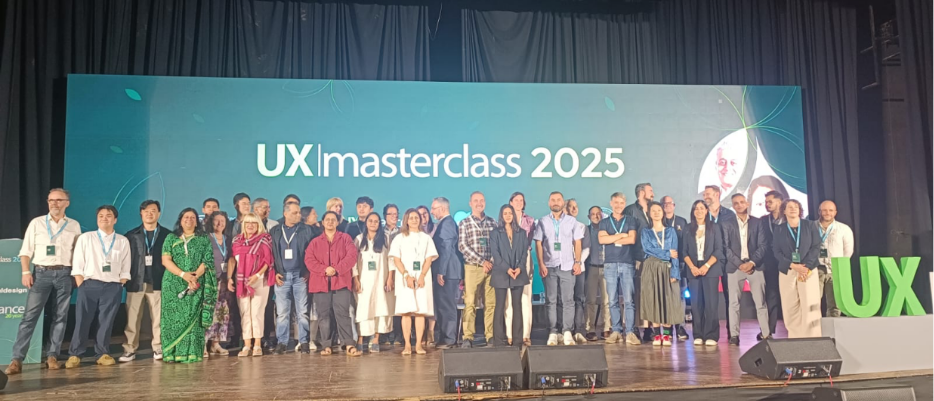
The 22nd edition of UX Masterclass was hosted by PeepalDesign in Bengaluru, India, on October 9 and 10, 2025. Under the theme “Navigating Uncertainty: The Future of UX Research”, the conference brought together over 200 professionals from across 30 countries. The programme included two keynotes, 15 talks, a panel discussion and four workshops—each exploring how UX research can stay resilient, relevant and responsible amid global change and technological disruption.
The event offered both a strategic outlook and practical methods to help researchers adapt and lead. Below is a full recap of the sessions and their key takeaways.
Keynotes
Fun, Flow, Futures
Naresh Narasimhan (VA Group)
Naresh used the redesign of Bengaluru’s Church Street to show how urban design parallels UX design. He highlighted how flow, clarity and inclusivity can reduce friction in both physical and digital systems.
Key takeaways:
- Urban design can apply UX principles such as flow, visibility and clarity.
- Reducing friction in physical spaces parallels digital experience design.
- Public spaces benefit from playful, inclusive and intentional design.
Playing With Ideas Mindfully
Indi Young (Author, Mental Models)
Indi challenged the audience to look beyond behaviour and understand cognition. She emphasised the importance of inclusive mental models in shaping design that supports a wide range of thinking styles.
Key takeaways:
- Move beyond “typical behaviours” to understand diverse thinking styles.
- Listen for cognition: what’s happening in people’s minds, not just their actions.
- Build solutions that support how different people approach the same goal.
- Use mindful, inclusive research to connect insights with measurable business outcomes.
Talks
Accelerating AI Innovation: The Transformative Power of Research
Niketa Jhaveri (Amazon, USA)
Niketa shared how research at Amazon shapes ethical and scalable AI experiences by aligning technology with human needs.
Key takeaways:
- UX research helps ensure AI tools solve real-world problems for real people.
- Aligning AI outputs with user context leads to more meaningful adoption.
- Cross-disciplinary collaboration is critical to building successful AI features.
Mind the AI Gaps in UX Research
Lindsey DeWitt Prat (Bold Insight, France/US)
Lindsey explored how AI tools can introduce cultural and linguistic bias into research. She urged teams to evaluate tools critically before applying them globally.
Key takeaways:
- AI tools can introduce bias when trained on limited cultural or linguistic data.
- Multilingual research requires checking for accuracy in transcription and interpretation.
- Researchers should assess how tools behave across contexts before trusting results.
Finding the Rhythm in Uncertainty
Jayawant Tewari (Microsoft, India)
Jayawant encouraged teams to treat uncertainty as a creative prompt. He shared practical frameworks to help researchers remain effective amid organisational change.
Key takeaways:
- Organisational change and disruption offer moments to rethink research.
- Frameworks provide structure without reducing flexibility.
- Resilient teams are built through clarity, alignment and trust.
Using JTBD to Shape Product Strategy
Victor Gutierrez (WhatsApp, USA)
Victor presented a practical approach to Jobs To Be Done, showing how aligning research with user intent helps prioritise product direction.
Key takeaways:
- JTBD helps teams stay grounded in the underlying problems users are trying to solve.
- Qualitative and quantitative data together support stronger prioritisation.
- Product roadmaps aligned to user goals outperform feature-focused planning.
From Hierarchies to Harmony
Tala El Hallak & Sudipt Shah (Digital of Things, UAE)
This session explored how evolving team structures, role clarity and individual growth paths are reshaping design organisations.
Key takeaways:
- Teams succeed when roles are clear and people are set up for the right kind of growth.
- Career paths in UX can focus on craft or people leadership—both add value.
- AI may reshape execution, but human skills like framing and storytelling are enduring.
Universal Design Research
Gavin Lew (Bold Insight, USA)
Gavin showed how inclusive research practices enhance usability and business value for all users—not just those with disabilities.
Key takeaways:
- Designing for inclusion benefits a broad spectrum of users.
- Accessibility practices must go beyond compliance to support usability.
- Research must include needs related to physical, cognitive and situational constraints.
Charting the Unknown: UX Research in the Age of AI
Shilpa Banerjee (Salesforce, India)
Shilpa explained how integrating AI into research workflows can accelerate delivery without compromising insight.
Key takeaways:
- AI can improve speed and scale, but must be implemented thoughtfully.
- Insight depends on human interpretation even with automated tools.
- Design teams need to shape workflows that combine AI and critical thinking.
Wake Up, Watch TV, Eat Food, Sleep, and That’s All
Leena Jain & Anoushka Sharma (PeepalDesign, India)
Through the lens of elderhood in India, this session explored emotional and embodied knowledge as a basis for meaningful UX.
Key takeaways:
- Empathy-driven research uncovers the emotional and embodied needs of older adults.
- Vulnerable populations require contextual sensitivity in both method and messaging.
- Narrative frameworks help stakeholders relate to insights beyond data.
How to Connect with Your Local Futures
Emilio Sosa & Andrea Gomez (Usaria, Mexico)
Drawing on work in the Mexican healthcare system, the speakers demonstrated how local foresight and participatory design shape socially responsible services.
Key takeaways:
- Foresight becomes meaningful when grounded in a specific cultural context.
- Participatory research builds relevance and collective ownership.
- Ethical design must consider long-term impact on systems and communities.
Lightning Talks
Dual Lens: Combining Data and Research for Early-Stage Decisions
Vidisha Hegde (ex-Spotify, India)
Key takeaways:
- Combining data and research improves confidence in early decisions.
- Internal rituals that align teams support better collaboration.
- Listening to both quantitative signals and qualitative stories leads to more balanced strategy.
Building an Anti-Fragile UXR Practice
Suruchi Biyani (Google, India)
Key takeaways:
- Anti-fragile teams grow stronger through change, rather than resisting it.
- Cultural context matters when designing resilient practices.
- Researchers should proactively build systems that adapt under pressure.
Latent Minds and Cultural Ambiguity
Ayumu Takeuchi (Mitsue-Links, Japan)
Key takeaways:
- UX research must include emotional nuance and implicit signals.
- Personas and assumptions can flatten cultural complexity.
- Supporting emotionally-aware AI requires richer qualitative methods.
Beyond Metrics: Designing for Sustainability
Ukasyah Qodratillah Ananda Putra (Somia CX, Indonesia)
Key takeaways:
- Metrics alone cannot drive responsible design.
- Designers must assess unintended outcomes and broader impact.
- Sustainable UX requires systems thinking beyond feature delivery.
Touch, Trust and Transformation: The Future of Automotive Interfaces
Jan Panhoff (UIntent, Germany) & Maffee Wan (XplusX, Singapore)
Key takeaways:
- Trust in interfaces grows through control, clarity and context.
- Local expectations and habits shape how drivers use features.
- UX must translate innovation into signals that users recognise and believe.
From Mockups to Real Products: Vibe Coding and AI Tools
Daniel Torres Burriel (Torresburriel Estudio, Spain)
Key takeaways:
- AI tools can speed up prototyping and development.
- Designers increasingly influence implementation, not just visuals.
- Learning how to use AI tools is a core skill for today’s design teams.
Panel Discussion – Navigating Uncertainty Together
Moderator: Gavin Lew (Bold Insight)
Panelists: Niketa Jhaveri (Amazon), Muzayun Mukhtar (Google), Sridhar Dhulipala (UIDAI)
Key takeaways:
- Collaboration across public and private sectors improves UX outcomes.
- UX researchers must participate in AI governance discussions.
- Government-led design can model ethical and inclusive research practices.
Workshops
Maximizing Research Efficiency with AI
Mentors: Tara Bosenick, Leena Jain, Arsh Ashwini Kumar, Maffee Wan
This workshop focused on how to use AI tools to streamline research processes, from synthesis to insight generation, while preserving quality and depth.
LEGO® Serious Play® for UX Challenges
Mentors: Durga Prasad Vemula, Shivani Khandelwal
Using the LEGO® Serious Play® method, participants explored creative problem-solving and alignment around shared goals in UX projects.
Introduction to ResearchOps
Mentors: Annemieke van Ruiten, Serena Montibeller
Participants examined how to build operational maturity within research functions, focusing on team workflows, governance and consistency.
Elevating UX Maturity
Mentors: Joëlle Stemp, Florian Egger, Rajesh Ghodke
This workshop introduced models and practices that support organisational UX maturity, helping teams align design impact with business goals.
Final Thoughts
UX Masterclass 2025 in Bengaluru made one thing clear: the future of research will be defined not just by tools or trends, but by the depth of understanding we bring to people’s lives and contexts. In uncertain times, resilient UX means being both globally connected and locally informed.
Next stop: UX Masterclass 2026 in Lisbon, October 14-15. Know more: https://www.uxmasterclass.com/