Close icon
close
Close icon
close
GET OUR UPDATES

Subscribe to our newsletter for updates on UX events, news and publications.

Check mark
Thank you for subscribing.
Something went wrong while submitting the form.
Check mark
Thank you for subscribing.
Something went wrong while submitting the form.

UX Masterclass 2024 Dubai – Key Takeaways

Discover the key insights from UX Masterclass 2024 in Dubai, covering AI, accessibility, research maturity and global UX best practices.

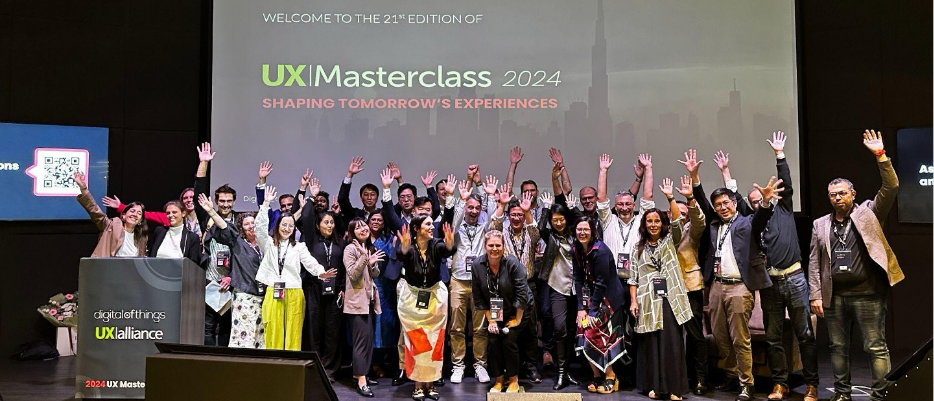
The theme for the 2024 21st edition of the UX Masterclass, "Shaping Tomorrow's Experiences: UX in the Era of Evolving Customers," explored the future of user experience. Attended by over 130 in-person participants in Dubai, UAE, this event marked the FIRST ever UX conference in the city. It brought together global experts to discuss the evolving landscape of customer expectations and how UX design will shape the experiences of tomorrow.

🗓️ 1 Day - A jam-packed schedule featuring inspiring keynotes, interactive workshops
🎤 17 Sessions - exciting sessions covering the latest in tech and creativity
🌍 18 Speakers - World-class UX professionals shaping the future of User Experience

Keynote

Decolonizing LLMs: An Ethnographic Framework for AI Alignment

Senior UX Researcher Chris Golias from Google opened the conference with a keynote focused on building inclusive AI systems through culturally grounded UX research. Drawing from work on internationalising large language models, he introduced a framework for aligning AI development with local knowledge systems.

Key takeaways:

  • Researchers must examine their own assumptions and understand users’ socio-political realities.
  • Co-designing with local communities ensures relevance and fairness in methodology and outcomes.
  • Cultural and linguistic nuance must inform data collection and interpretation.
  • Findings should be applied collaboratively, with sustained involvement from local partners.

Main Talks

Context Matters: Enhancing UX through Ethnography

Kristine Pitts, Director of UX at telecom provider du in the UAE, shared how ethnographic methods helped address design challenges in a highly diverse and tech-forward region. Her talk highlighted the importance of local context in crafting relevant user experiences.

Key takeaways:

  • Ethnography provides valuable cultural and behavioural insight that improves product relevance.
  • In multicultural environments like the UAE, one-size-fits-all UX does not work.
  • Observational research, especially in healthcare settings, can transform service experiences.
  • Long-term, mixed-methods research delivers deeper understanding.

Boost Customer Value: Global Consistency Meets Local Relevance

UX researcher Paola Seghezzi and service designer Anna Lazzati from Assist Digital shared a case study on how L’Occitane approached customer experience design across multiple markets. Their project combined data from local offices with global strategy to improve consistency and value.

Key takeaways:

  • Customer expectations evolve depending on context and life stage.
  • Research questions must be renewed continuously and informed by local realities.
  • Integrating quantitative and qualitative methods yields both standardised and customised insights.
  • Implementation succeeds when global coordination respects local specifics.

To UX, from CorpX: Re-engineering Legacy Organisations

Faris El Mahgiub, a corporate transformation strategist and adjunct professor, explored why UX often struggles to take root in large organisations. He challenged common assumptions about organisational barriers and proposed an alternative focus on changing internal metrics.

Key takeaways:

  • Embedding UX is not about fixing silos or adding more tools—it is about redefining what success looks like.
  • The behaviours that matter are shaped by the metrics being tracked.
  • Lasting UX integration requires organisational change, not isolated process improvements.

The Rise of the Ethical Consumer: Designing for Values-Driven Users

Katral-Nada Hasssan, Head of Design at Saudi fintech company Alraedah, focused on how UX teams can support ethical consumer behaviour. She shared examples from the financial sector where product design influenced values-based decision-making.

Key takeaways:

  • Designers should align their own values with those of the company and the product.
  • Interfaces can help users make more ethical decisions by showing transparent benefits.
  • Empathy-driven communication supports user trust and long-term engagement.

Navigating Digital Evolution and Cultural Nuances in MENA

Sudipt Shah, founder and CEO of Digital of Things, presented a regional overview of digital trends in the Middle East and North Africa. His session focused on the cultural and demographic complexity of designing for this rapidly changing region.

Key takeaways:

  • UX must reflect local customs, languages, and user expectations.
  • Arabic content and mobile-first design are critical in MENA, where smartphone usage exceeds 99%.
  • Avoid direct translation—design for cultural resonance.
  • Regular testing with local users is essential to remain relevant.

Design in the Era of AI and Intelligent Services

Wojciech Chojnacki, Strategy Director at Symetria in Poland, encouraged participants to rethink how UX design supports human–AI interaction. He argued that designers must move beyond screen-based workflows to design intelligent service experiences.

Key takeaways:

  • Context is key to building AI experiences that feel meaningful and useful.
  • Designers must define the right level of support and autonomy that AI should provide.
  • The focus should be on collaboration between humans and machines—not automation alone.

A11y: Universal Design Research

Gavin Lew, Managing Partner at Bold Insight in the United States, addressed the critical role of accessibility in today’s product ecosystems. He outlined the business case for inclusive design and how universal accessibility benefits everyone.

Key takeaways:

  • Accessibility increases reach and usability across demographics.
  • Design systems must support inclusion from the start, not as an afterthought.
  • Omni-channel products require end-to-end accessible experiences.
  • Regulatory pressure is increasing in many markets, making compliance a priority.

Lightning Talks

Unlocking the Hidden Potential: What Else Can a Car Be?

Maffee Peng Hui Wan, Managing Director at XplusX in China, examined how the meaning and use of cars are evolving in Asia. She shared how cockpit design is shifting towards multifunctionality, particularly in urban Chinese contexts.

Key takeaways:

  • Vehicle UX must reflect lifestyle, not just transportation needs.
  • Interaction design must respond to cultural preferences and expectations.
  • The same feature can be interpreted differently across markets.

The Future of Recruitment: Nationality, Diversity and Client Needs

Adam Symonds, UX researcher at Digital of Things in Dubai, explored the limitations of demographic-based recruitment. He advocated for more behaviour-based criteria when selecting research participants.

Key takeaways:

  • Recruitment should be based on usage patterns, not assumptions about identity.
  • Customer support teams and social listening can inform better recruitment briefs.
  • Data-informed personas create more relevant research outcomes.

UX-PM Design Maturity Score

Joëlle Stemp from Yu Centrik in Canada introduced the UX-PM maturity score, a free tool that helps teams assess and benchmark their UX capability.

Key takeaways:

  • The tool supports strategic decision-making around design investment.
  • It provides a shared vocabulary for internal UX maturity conversations.
  • Easy to use and widely applicable across industries.

Creating Engaging Immersion Experiences

Mrudula Sreekanth, COO at PeepalDesign in India, discussed how immersion techniques can help stakeholders develop empathy and insight into users’ lives.

Key takeaways:

  • Immersions include shadowing, intercepts, in-lab and market visits.
  • The goal is cultural understanding, not report generation.
  • First-hand experience fosters shared alignment and learning.

Expectations Evolve, Humans Don’t

Bob Schumacher, Co-founder of UXalliance and partner at ReSight Global, reminded the audience that while technology and user expectations shift, human cognition does not.

Key takeaways:

  • User-centred design should be grounded in behavioural science, not just feedback.
  • Designers must balance innovation with human constraints.
  • Expertise and empathy remain the foundation of good UX.

Panel Discussion

Mastering UX Research: Global Perspectives

Moderated by Annemieke van Ruiten from Assist Digital and Frédéric Gaillard from Devoteam, this panel brought together voices from South Africa, South Korea, Poland, India, the United States and the UAE. The conversation focused on operational and strategic challenges in global UX research.

Key takeaways:

  • Demonstrating business impact is key when selling UX to new clients.
  • Research across markets requires cultural fluency and adaptable methods.
  • AI can support scale, but must be used responsibly.
  • Future-proof skills include collaboration, communication, and strategic insight.

Looking Ahead

UX Masterclass 2024 reinforced the value of global collaboration, cultural perspective and research excellence. Each session reflected the growing complexity of UX work and the need for flexible, context-aware approaches.

The next edition of UX Masterclass will be hosted in Bengaluru, India, in 2025.

MORE PUBLICATIONS