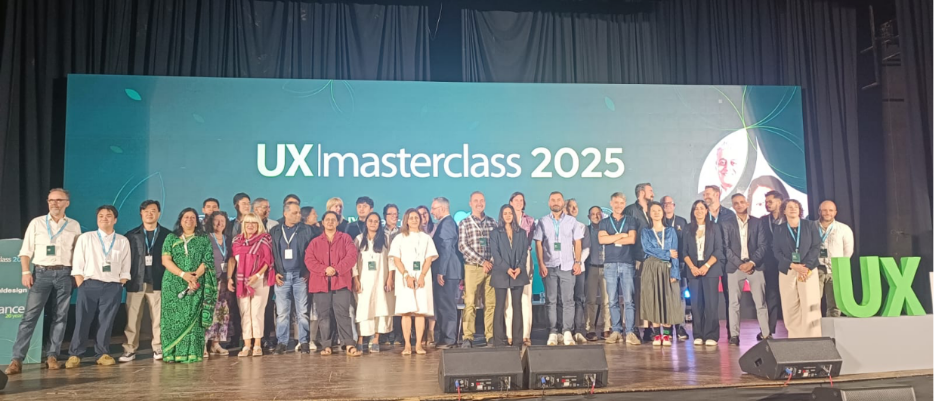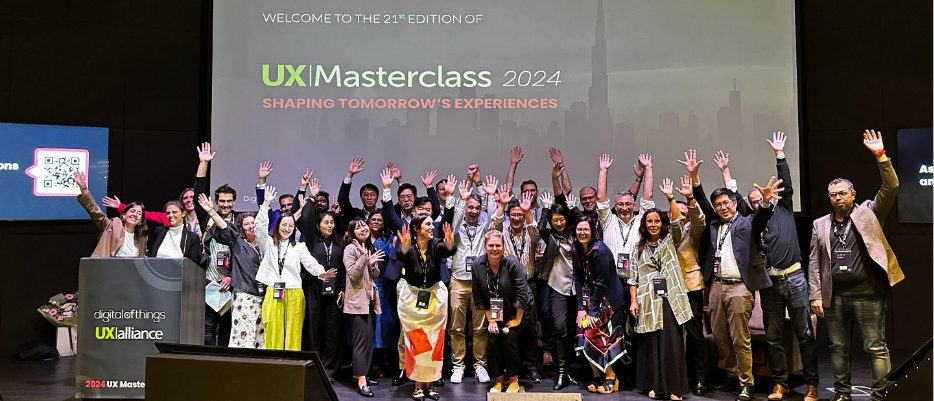
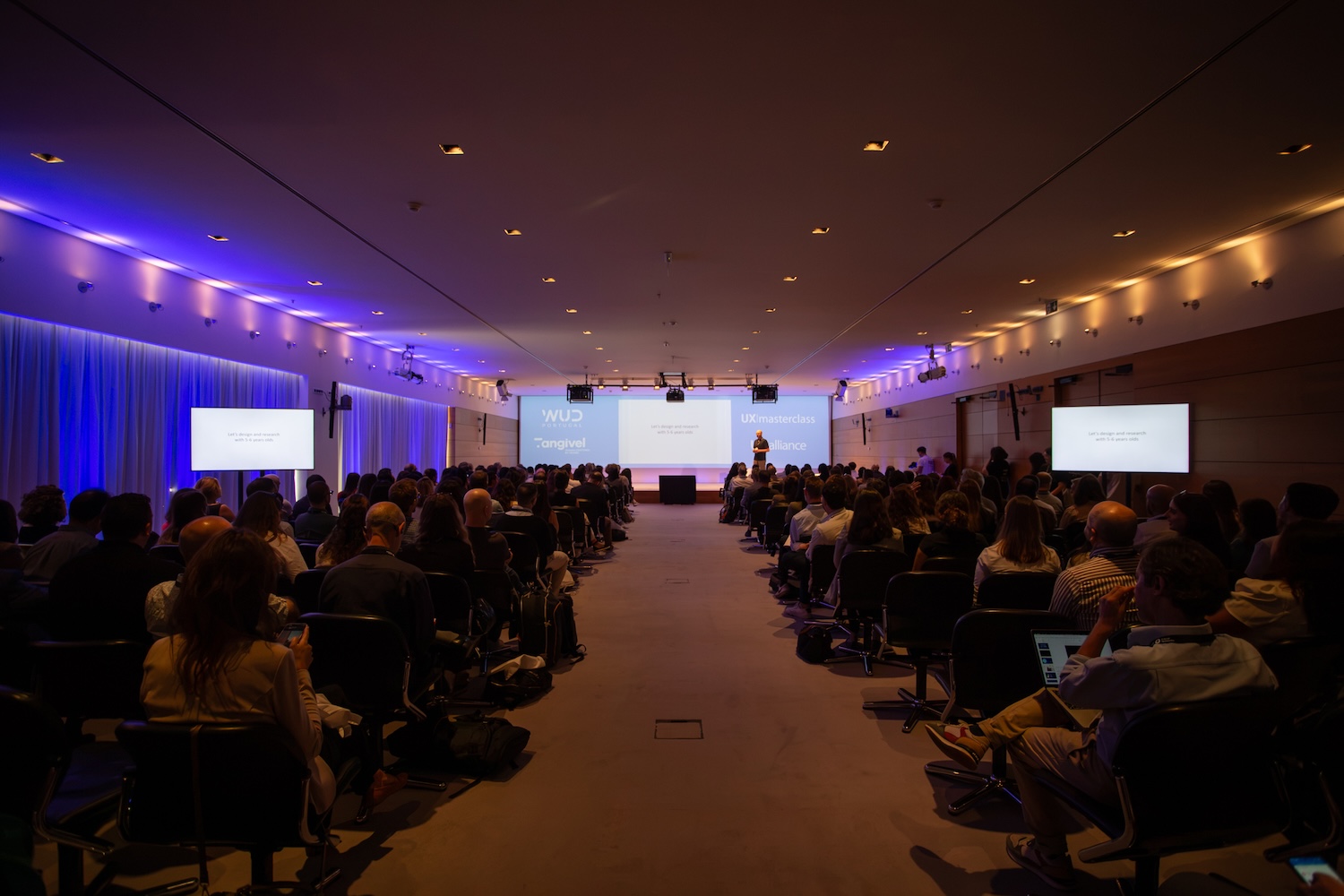
The 23rd edition of UX Masterclass was hosted by Tangível in Lisbon, Portugal, on October 14 and 15, 2026. Under the theme “Bridges to Tomorrow: Connecting Innovation to Human Experience”, the conference brought together more than 200 professionals from 69 organisations. The program included 6 hands-on workshops on the first day and 13 talks on the second, each exploring how UX can keep people at the centre as AI reshapes products, teams and research.
Participants rated the event 9.1 out of 10. They singled out the quality of the speakers, the energy in the room, and the international mix. Below is a full recap of the sessions and their key takeaways.
Talks
Young Humans, Big Insights: Involving Children in Design and Development with AI and Remote Methods
Thomas Visby Snitker (Brugercentrisk AI, Denmark)
Thomas, who led Kids Experience research at LEGO for 12 years, showed that children and adults read the same product very differently. He explained how “play invitations” help close the gap between what people say, do and mean, and what remote and AI methods add to that work, including their risks.
Key takeaways:
- You are not your user: adults notice text and logos, while children notice characters and story potential.
- Swap interviews for play invitations: role-play and open prompts unlock natural storytelling.
- Follow the energy and stop on a high, because playfulness dies when energy drops.
- Bring play into professional work: gamified tools make collaboration more engaging.
Please Don’t Make It Easy
Marília Moita (Oracle NetSuite, Portugal)
After 18 months running work and family life with four named AI agents, Marília showed that removing friction can also remove the need to remember, think and judge. Voted the audience favourite, her talk argued that the UX question is shifting from usability to what a system enables people to become.
Key takeaways:
- Removing friction can also remove memory, curiosity, problem-solving and judgement.
- Not all friction is waste: reflective, protective and learning friction is worth keeping.
- The key question moves from “Is it easy to use?” to “What does it enable people to become?”
- Decide deliberately which tasks to automate and which decisions stay human.
The Shape of Tomorrow’s UX Team – and the Skills Gap Nobody Is Talking About
Sudipt Shah (Digital of Things, UAE)
Sudipt showed how AI is collapsing the product process and blurring the lines between product management, research, design and engineering. With entry-level roles shrinking, he set out concrete actions for leaders to protect the skills that matter most.
Key takeaways:
- Role boundaries are dissolving: PMs wireframe, designers ship code and researchers strategise.
- Craft is built through repetition and judgement through mistakes, and AI is removing that training ground.
- Fewer junior roles today means fewer senior designers in five years.
- Leaders should redesign junior roles so that AI generates and juniors evaluate, and hire for thinking, not tools.
MB WAY: A Success Story. Not by Chance, by Design.
Solange Ferreira, José Sales & Vítor Carvalhinho (SIBS and Tangível, Portugal)
MB WAY grew from 600,000 users in 2018 to 7 million, around 70% of Portugal, with more than 1 billion transactions a year and the highest engagement of any European digital wallet. The speakers showed how eight years of embedded partnership made research a habit, with a fast method matched to every decision.
Key takeaways:
- Design didn’t create the demand; it removed the friction so growth could happen.
- Research works best as a habit, not an event: more than 30 studies over eight years.
- Ask “What’s the fastest honest answer?” rather than “What’s the most traditional method?”
- Trust is a design material: convenience is welcome, but losing control is not.
Designing Financial Products for Real Human Relationships
Ketut Sulistyawati & Marcella Pratama (Somia CX and blu by BCA Digital, Indonesia)
A year-long study for the digital bank blu, using diary studies, focus groups and ideation workshops in four Indonesian cities, found that money is shared between couples, families and communities. Yet most banking apps are built for a single user. The speakers introduced the Relation-Ships Blueprint to design for shared financial life.
Key takeaways:
- Money lives in relationships and carries emotion and meaning, not just transactions.
- Banking apps act like single-player ledgers; design for the relationships around them instead.
- Layer design principles across functional (who sees and controls what), social and emotional needs.
- Design for the journey, not just the passenger.
Moving the Needle: How to Improve AI Outcomes
Joannes Vandermeulen (Namahn, Belgium)
Joannes argued that UX professionals shape how AI touches people, which puts them in a strong position to reduce risks and strengthen human oversight. He proposed bringing several AI models into the room to surface evidence, alternatives and disagreement, while people keep responsibility for the decision.
Key takeaways:
- Desire for AI and fear of AI together drive both underuse and “shadow AI”.
- Regulation such as the EU AI Act is an opportunity for human-centred designers.
- Use AI to help people think together, not to make decisions for them.
Researching the Future: The Future of Research
Mel Wadey (Sutherland Labs, UK)
Mel showed how user research can feed strategic foresight by spotting tomorrow in today’s behaviour. Her example was a carpenter in his 60s, no early adopter, who used a voice AI assistant in real time to inspect a vintage motorbike and negotiate its price.
Key takeaways:
- Look for behavioural weak signals: fringe workarounds today often hint at tomorrow’s mainstream.
- Technology shows what is possible; behaviour shows what is likely.
- People describe today’s routines well but are poor at predicting their own future choices.
- Use the Three Horizons framework and ask, “If this, then what?”
Bridging the Gap: Human Dynamics and Cultural Alignment
Marta Monterde Alonso (Torresburriel Estudio, Spain)
Marta described organisations as a cultural iceberg, where what is visible is driven by values and assumptions below the surface. Drawing on stakeholder mapping, psychological safety and cultural frameworks, she shared practical rules for working across disciplines and cultures.
Key takeaways:
- Agree on the words before the wireframes: misaligned teams ship misaligned products.
- Map people by power and interest, and give every task one clear owner to find hidden blockers early.
- Psychological safety means being safe to challenge, not being nice.
- A good partner works below the waterline, not just above it.
Synthetic Users: Not a Replacement, an Amplifier
Laura Russo (Assist Digital, Italy)
Laura tested three common promises about synthetic users – that they are neutral, near-human and plug-and-play – and showed where they fall short. Built on a solid knowledge base with clear governance, she argued, they can still make real research faster, more focused and leaner.
Key takeaways:
- Synthetic users imitate a customer base, but they don’t live its reality.
- Think of them as a dial, not a switch: they suit structured tasks, while real research leads where people are unpredictable.
- Quality depends on the knowledge base and governance; there are no shortcuts.
- Use them to test your questions before you ask real customers.
State of UX in Portugal: From a First Snapshot to the Full Picture
Joana Castro (UXPA Portugal, Portugal)
Joana revisited the 2024 State of UX survey, run with Tangível, which gave the first real data on UX work in Portugal. She launched the 2026 edition on stage, aiming for more than 500 responses and a free report in early 2027.
Key takeaways:
- The workforce is international: 26% are not Portuguese, and 96% work remotely or hybrid.
- One in three work for a company headquartered outside Portugal.
- Pay remains low: 43% earn under €30,000 gross a year, and only 12% earn over €60,000.
- Apparent pay gaps may reflect experience rather than location or gender, so more data is needed.
From Designers to Product Creators – Redefining Roles and Skills
Wojciech Chojnacki (Symetria, Poland)
Wojciech argued that AI has made building cheap, so the main product risk has flipped from building the wrong thing to “death by mediocrity”. He introduced the AI Product Skills Map, covering Vision, Execution and Collaboration, and three emerging roles for product creators.
Key takeaways:
- Building is no longer the edge; knowing what is worth building, for whom and why, is.
- Context matters: one sentence builds an app, but good context builds a product.
- Collaboration scored lowest of the three areas in the beta assessment.
- Future roles combine two of the three areas, so identify your top two.
The Living Repository: Scaling Human Insight in the Era of AI
Emilio Sosa Estrada (Usaria and Kinmat, Mexico and Colombia)
Emilio warned that fast AI research flattens cultural nuance, misses the billions of people who are offline and cannot build rapport. Drawing on a UXalliance study of AI adoption across 12 countries, he introduced Kinmat, a living repository that grounds AI in validated research.
Key takeaways:
- Without a human in the loop, you get a stereotype, not an insight.
- Rapport can’t be synthesised, and face-to-face research still matters for sensitive topics.
- AI is the copilot, not the captain: route every suggestion through a local researcher.
- Ground AI in validated research and keep the user’s voice at every step.
Every Researcher a Futurist: Embedding Foresight into Your UXR Practice
Carolyn Wei (Independent UX Researcher, USA)
Carolyn showed that teams don’t need a dedicated futures function, just a lightweight foresight practice every researcher can fold into existing work. She shared the AI-assisted trend-tracking routine she used at Instagram: frame, scan, synthesise and act.
Key takeaways:
- Frame a sharp question that names the audience, the behaviour and the decision it informs.
- Let AI do the reading while you do the editing, and check every citation.
- Test signals against your own users’ data, and keep the minority signals.
- Every pattern needs a next move: ask, study, watch or hold.
Workshops
Design Maturity Model
Facilitators: Catarina Latas & Florian Egger, with UX-PM
Participants scored their own organisation on the six dimensions of the UX-PM Design Maturity Score, compared results in groups and wrote “How might we” recommendations for their two weakest dimensions. A public-sector case study and a phased roadmap showed how maturity grows step by step.
Vibe Coding with Lovable
Facilitator: Ricardo Luiz, with Lovable
This hands-on build covered advanced Lovable workflows: organising personas, prompts and documentation, then designing the front end and back end, including permissions, payments and AI automations.
Speculative Design
Facilitators: Valerio Antonietti, Marzia Battaglia & Camilla Briganti
Using the Futures Cone, participants created artefacts for possible future scenarios and debated the ethical and strategic implications of emerging trends, shifting the focus from problem-solving to problem-finding.
LEGO® SERIOUS PLAY®
Facilitators: Joelle Stemp & Mrudula Sreekanth
Participants built models to explore how their professional identity might change with AI. One group of young UX professionals imagined a future that ended closer to nature and self-sufficiency – a weak signal of a wish to disconnect, or a playful provocation worth watching.
AI Fluency for UX
Facilitators: Maffee Wan, Liam Miao, Ayumu Takeuchi & Honoka Sumida
The most popular workshop of the day was built around the 5C Loop: Context, Complexity, Collaboration, Critique and Consensus. Participants wrote, ran and fixed prompts, checked a peer’s AI summary against its source, explored how consumers in China and Japan use AI, and turned their best prompt into a reusable skill.
ResearchOps
Facilitators: Daniel Torres Burriel & Ana Mackay, with UX-PM
This workshop explored why ResearchOps frameworks fail when they focus only on process efficiency, and how to scale research as an organisational learning system that turns knowledge into action.
Final Thoughts
UX Masterclass 2026 in Lisbon made one thing clear: as AI makes building faster and cheaper, the value of UX lies in judgement, context and the human connections that technology cannot replace. Building bridges to tomorrow means choosing carefully what to automate and keeping people at the centre of every decision.
Thank you to Tangível for hosting, and to every speaker, facilitator and participant who made this edition possible.
Next stop: UX Masterclass 2027 in Seoul, on 28 October 2027.