
A Paradigm Shift: From Interface to Behaviour
Cognitive design is the practice of designing interfaces around the perceptual, cognitive and motor limits of human information processing, so that the system absorbs mental work instead of imposing it on the user.
Cognitive Design represents the evolution of traditional systems design — which confined itself to organising and presenting information — into an approach that actively supports human thought. The discipline is concerned with designing interfaces that align closely with users' capacities and limitations, applying the science of the brain to create products compatible with the way we process data.
In professional practice, this evolution shows up less as a new label than as a change in what clients ask for. As Mark Brady (Sutherland Labs) observes, briefs have moved away from the interface itself and towards behaviour:
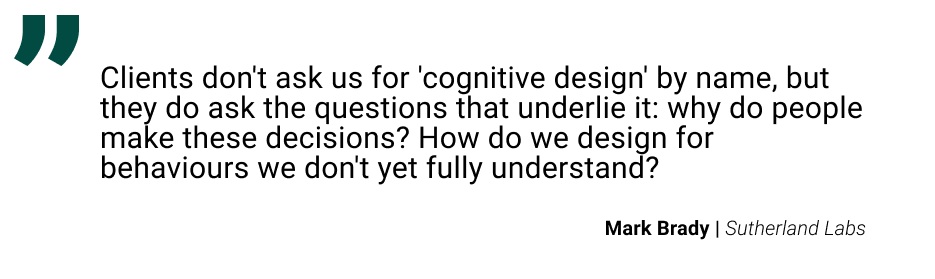
The gap, then, is not conceptual but operational — the knowledge exists and mostly fails to reach the decisions that matter.
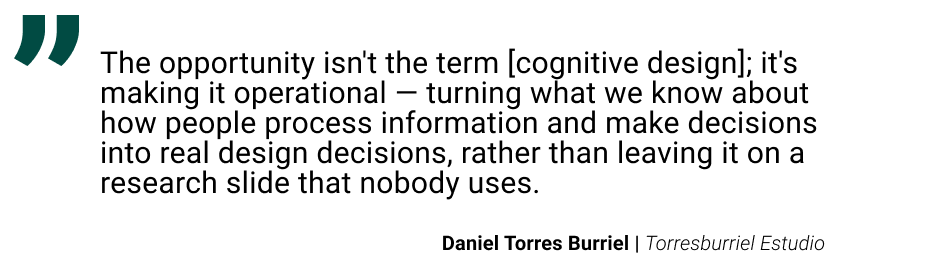
The Founding Principle: Cognitive Compatibility (and Gerhard-Powals' 10 Principles)
The foundational principle of cognitive design holds that the interface must be compatible with the perceptual, cognitive and motor properties of human processing. This alignment operates at several levels:
- Stimulus–Response (S–R) compatibility;
- Spatial compatibility and frames of reference;
- Affective, proximity and ideomotor compatibility.
Translating this into practice is where Jill Gerhard-Powals's work matters. Rather than proposing principles on theoretical grounds, she tested them empirically — comparing interfaces designed with and without cognitive engineering principles and measuring the difference in task performance. The resulting ten principles share a single objective: to free cognitive resources for higher-order tasks by removing the work the system should be doing itself.
- Automate unwanted workload (e.g.colour coding);
- Reduce uncertainty through clearly presented data;
- Fuse data into high-level summaries in order to reduce load;
- Provide interpretive aids (familiar metaphors and schemas);
- Use names that are conceptually related to function;
- Group data logically and consistently;
- Limit data-driven tasks through graphical presentation;
- Include only the information that is necessary;
- Employ multiple coding of data to support cognitive flexibility;
- Apply judicious redundancy, balancing consistency against relevance.
Nearly three decades on, the list reads as a critique of most AI-augmented interfaces shipping today.
Cognitive Load, Mental Models and the PCOF Model
Extraneous cognitive load is the mental effort a user spends on the interface rather than on the task — the load produced by how information is organised, not by the problem being solved.
The central aim of modern UX is the minimisation of extraneous cognitive load — the unnecessary mental effort produced by disorganised design rather than by the task itself.
One recent attempt to map that effort systematically is the PCOF model (Perception, Cognition, Operation, Feedback), proposed by He (2026) from the study of physical switch interactions in smart vehicle cockpits. The model traces the full arc of an interaction, from sensory acquisition through to system confirmation, and its origin matters: in a cockpit, a badly designed feedback loop does not produce mild frustration but a lapse in situational awareness.
This multidimensional view accounts for six critical processes: vision and attention, orientation, memory, language, decision-making and emotion. The Six Minds framework, drawn from John Whalen's Design for How People Think, gives designers a practical checklist for verifying that a product activates the right mental models rather than assuming it does.
That last point is where AI systems most often break. PCOF describes how the system is structured; the mental model describes what the user expects it to do. When an interface filters, ranks or summarises on a logic the user cannot reconstruct, the two diverge — and trust becomes a cognitive cost rather than an emotional bonus. Anna Schneider (Symetria) notes that this erosion is fast and hard to reverse, whether the cause is unexplained filtering or walls of text that ignore how much a person can actually process.
This pattern has emerged consistently across Symetria's research on AI interfaces with organisations in banking, pharmaceutical, e-commerce and automotive sectors. The team uses those findings to validate AI concepts before investment, define MVP features based on observed behaviour, and design adaptive experiences that preserve the user's sense of control while reducing cognitive load.
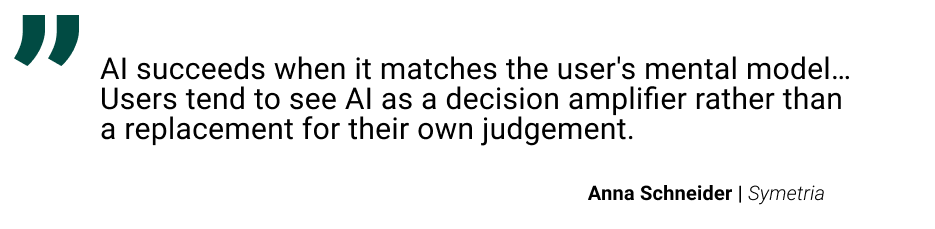
The design consequence is concrete: reasoning has to be visible at the moment of the decision, not buried in a settings panel.
Emotion is not a separate layer in any of this. Mgbeafulike et al. (2026) argue that mental efficiency and emotional satisfaction are inseparable in HCI: positive affect broadens attention, while stress narrows it and raises error rates. An interface that is cognitively "correct" but produces anxiety is not, in practice, cognitively correct.
What are Adaptive User Interfaces (AUIs)?
An adaptive user interface (AUI) is a system that changes its own layout, content or functionality automatically, based on the user's behaviour, profile or context of use. Unlike a customisable interface, which the user configures deliberately, an AUI decides on the user's behalf — which is why every adaptation carries a cognitive cost of its own.
Adaptive User Interfaces (AUIs) allow systems to alter their layout and functionality dynamically in order to accommodate the user and their context of use. The difficulty is that adaptation is never free: rearranging an interface imposes its own cognitive cost, which has to be smaller than the cost it removes.
Findlater and Gajos, working comparatively across adaptive menu designs, sorted the available strategies into two families:
- Spatial adaptation: moving, resizing, hiding or inserting elements.
- Visual adaptation: highlighting through colour or typography, and ephemeral adaptations that decay over time.
Their finding is consistent and inconvenient: spatial adaptation is the more powerful of the two and also the more damaging, because it disrupts the spatial memory users depend on to work quickly.
Deuschel's review of the field adds a second constraint — human factors such as spatial memory, age, gender and predictability are decisive for whether an AUI succeeds. Predictability in particular tends to outweigh accuracy: users resist adaptation they cannot anticipate, even when it is objectively correct.
It follows that AUIs do not benefit all users equally. Personality traits and individual baseline levels of cognitive load change whether a given adaptation helps or hinders. This is also where neurodiversity enters. If adaptation is calibrated to an average processing profile, it optimises for a user who does not exist — and can actively penalise those who process information differently.
Eight Principles for Designing Adaptive Interfaces
Across this body of work — cognitive engineering, adaptive interfaces, machine learning applied to UI — a set of recurring recommendations emerges. They are worth reading as the current state of the evidence rather than as settled practice:
- Preserve spatial stability. Findlater and Gajos find consistently that moving elements degrade the spatial memory users rely on to work quickly.
- Make adaptation optional. Deuschel identifies predictability as decisive for AUI success; systems that adapt without asking tend to be resisted even when the adaptation is correct.
- Optimise the adaptive algorithm for accuracy. Hasan et al. (2026) report Random Forest performing well for adaptive mobile banking interfaces — a reminder that a poorly performing model makes adaptation worse than no adaptation at all.
- Respect perceptual and motor constraints, the founding compatibility principle set out in Section 2.
- Account for individual differences, including personality traits and baseline cognitive load.
- Minimise extraneous cognitive load at every interaction (Gerhard-Powals; Talbert, 2016).
- Ground decisions in cognitive science rather than in interface convention.
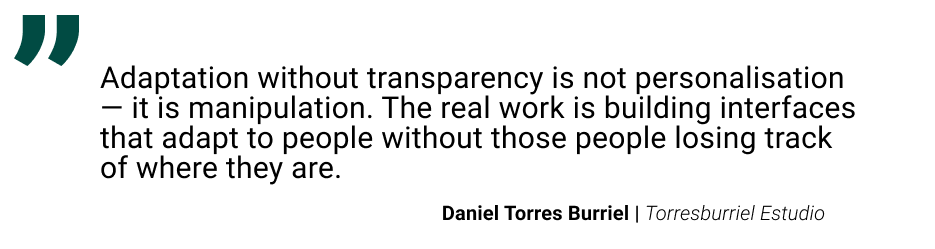
- Address technological limits transparently — Torres Burriel's point about the line between adaptation and manipulation.
How to Validate Adaptive Interfaces: EEG, Cognitive Mapping, Walkthrough
If the literature agrees on anything, it is that these systems cannot be validated by opinion. Self-reported satisfaction does not detect cognitive load; users routinely report that an interface felt fine while their performance says otherwise.
The methodological response has been to triangulate. Gaspar-Figueiredo et al. (2023) used EEG (electroencephalogram) to measure the cognitive cost of adaptive interfaces in real time, replicating earlier findings and showing that adaptation carries a measurable overhead even when users say they prefer it. Taraghi et al.(2023) applied cognitive mapping to surface the reasoning behind user needs rather than the needs themselves. Tiyasa et al. (2023) combined goal-directed design with cognitive walkthrough to test whether a product's logic matches the user's before a line of code is written. None of these substitutes for the others; the point is that behavioural claims now require behavioural evidence.
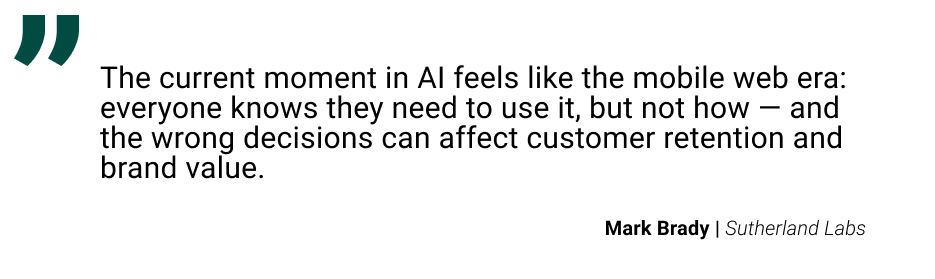
This is also why research has moved out ofthe discovery phase and into strategy. The commercial stakes are no longerabstract:
The network's contribution to this specific problem is comparative. Mental models are not universal, and an adaptation that reduces load in one market can raise it in another — through a different reading direction, a different relationship to automated decisions, a different tolerance for being anticipated. Testing that assumption requires research running in more than one place at once.
Conclusion
Cognitive Design provides the framework for compatibility with human mental architecture; AUIs supply the technology for dynamic personalisation. Neither is sufficient alone, and both are easy to implement badly. What holds them together is evidence: rigorous measurement of what an interface actually costs the person using it, paired with the transparency that lets that person stay in charge of the outcome. On those terms, systems can act as empathetic partners, anticipating needs without ever compromising user agency and control.
References
Deuschel, T. (2018). On the influence of human factors in adaptive user interface design. In Adjunct publication of the 26th Conference on User Modeling, Adaptation and Personalization (pp.187–190). Association for Computing Machinery. https://doi.org/10.1145/3213586.3213587
Findlater, L., & Gajos, K. Z. (2009). Design space and evaluation challenges of adaptive graphical user interfaces. AI Magazine, 30(4), 68–73. https://doi.org/10.1609/aimag.v30i4.2268
Gaspar-Figueiredo, D., Abrahão, S.,Insfrán, E., & Vanderdonckt, J. (2023). Measuring user experience of adaptive user interfaces using EEG: A replication study. In Proceedings of the 27th International Conference on Evaluation and Assessment in Software Engineering (pp. 52–61). Association for Computing Machinery. https://doi.org/10.1145/3593434.3593452
Gerhardt-Powals, J. (1996). Cognitive engineering principles for enhancing human–computer performance. International Journal of Human–Computer Interaction, 8(2), 189–211. https://doi.org/10.1080/10447319609526147
Hasan, K., Islam, M. R. U., Arafat, S. E.,& Islam, I. (2026). Adaptive user interface for mobile banking apps: Enhancing UX through machine learning. Array, 30, Article 100901. https://doi.org/10.1016/j.array.2026.100901
He, B. (2026). The PCOF model: A cognitive framework for designing physical switch interactions in smart vehicle cockpits. IEEE Access. Advance online publication. https://doi.org/10.1109/ACCESS.2026.3672684
Mgbeafulike, I. J., Okeke, O. C., Nwakeze,O. M., Umerah, A. T., Nwabudike, U. C., & Chidi-Onuigbo, C. (2026). The impact of cognitive and emotional factors on user experience in HCI. African Scientific Reports, 5(2), Article 421. https://doi.org/10.46481/asr.2026.5.2.421
Talbert, M. (2016, July 20). Social fishing:Reducing cognitive load: The best UX design for your community site. Newstex Trade & Industry Blogs.
Taraghi, M., Armellini, F., & Imbeau,D. (2023). An exploratory investigation of cognitive mapping for analyzing needs in UX design. IEEE Transactions on Engineering Management. Advanceonline publication. https://doi.org/10.1109/TEM.2023.3277432
Tiyasa, A., Wirdiani, N. K. A., & Rusjayanthi, N. K. D. (2023). Analysis and design of UI and UX of the Taring application using goal-directed design and cognitive walkthrough methods. Matrix: Jurnal Manajemen Teknologi dan Informatika, 13(3), 142–156. https://doi.org/10.31940/matrix.v13i3.142-156
Whalen, J. (2019). Design for how people think: Using brain science to build better products. O'Reilly Media.
Deuschel, T. (2018). On the influence of human factors in adaptive user interface design. In Adjunct publication of the 26th Conference on User Modeling, Adaptation and Personalization (pp.187–190). Association for Computing Machinery. https://doi.org/10.1145/3213586.3213587
Dinata, A. R., Hardiansyah, F., & Sari,J. F. (2025). Designing emotionally adaptive interfaces: Affective UX model for enhancing engagement in gamified learning apps. International Journal of Graphic Design, 3(2), 247–262. https://doi.org/10.51903/ijgd.v3i2.3098
Findlater, L., & Gajos, K. Z. (2009). Design space and evaluation challenges of adaptive graphical user interfaces. AI Magazine, 30(4), 68–73. https://doi.org/10.1609/aimag.v30i4.2268
Gaspar-Figueiredo, D., Abrahão, S., Insfrán, E., & Vanderdonckt, J. (2023). Measuring user experience of adaptive user interfaces using EEG: A replication study. In Proceedings of the 27th International Conference on Evaluation and Assessment in Software Engineering (pp. 52–61). Association for Computing Machinery. https://doi.org/10.1145/3593434.3593452
Gerhardt-Powals, J. (1996). Cognitive engineering principles for enhancing human–computer performance. International Journal of Human–Computer Interaction, 8(2), 189–211. https://doi.org/10.1080/10447319609526147
Gonzales, T. M. (2020). [Review of the book Design for how people think: Using brain science to build better products, by J. Whalen]. IEEE Transactions on Professional Communication, 63(4),402–403. https://doi.org/10.1109/TPC.2020.3024408
Hasan, K., Islam, M. R. U., Arafat, S. E.,& Islam, I. (2026). Adaptive user interface for mobile banking apps: Enhancing UX through machine learning. Array, 30, Article 100901. https://doi.org/10.1016/j.array.2026.100901
He, B. (2026). The PCOF model: A cognitive framework for designing physical switch interactions in smart vehicle cockpits. IEEE Access. Advance online publication. https://doi.org/10.1109/ACCESS.2026.3672684
Mgbeafulike, I. J., Okeke, O. C., Nwakeze,O. M., Umerah, A. T., Nwabudike, U. C., & Chidi-Onuigbo, C. (2026). The impact of cognitive and emotional factors on user experience in HCI. African Scientific Reports, 5(2), Article 421. https://doi.org/10.46481/asr.2026.5.2.421
Ramli, M. H., Jantan, A. H., Kamaruddin,A., & Abdullah, R. H. (2019). The adaptive model driven approach forenhancing usability of user interface design: A review process. In Proceedings of CHIuXiD 2019: The 5th ACM In Cooperation International Conference in HCI andUX (pp. 65–69). Association for Computing Machinery. https://doi.org/10.1145/3328243.3328252
Talbert, M. (2016, July 20). Socialfishing: Reducing cognitive load: The best UX design for your community site. NewstexTrade & Industry Blogs.
Taraghi, M., Armellini, F., & Imbeau,D. (2023). An exploratory investigation of cognitive mapping for analyzing needs in UX design. IEEE Transactions on Engineering Management. Advanceonline publication. https://doi.org/10.1109/TEM.2023.3277432
Tiyasa, A., Wirdiani, N. K. A., &Rusjayanthi, N. K. D. (2023). Analysis and design of UI and UX of the Taring application using goal-directed design and cognitive walkthrough methods. Matrix:Jurnal Manajemen Teknologi dan Informatika, 13(3), 142–156. https://doi.org/10.31940/matrix.v13i3.142-156
Whalen, J. (2019). Design for how people think: Using brain science to build better products. O'Reilly Media.